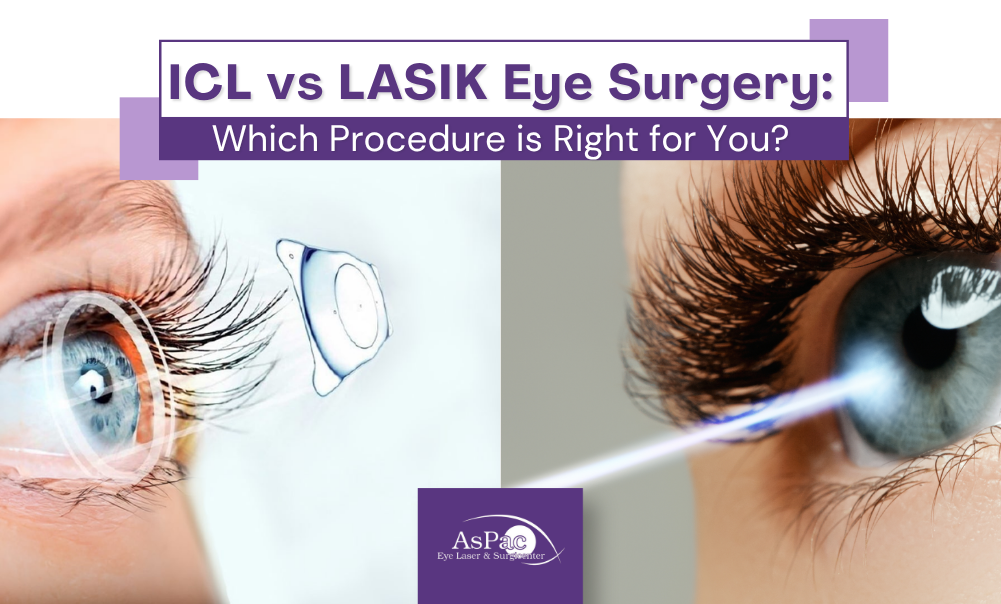
If you are looking for effective surgical ways to have clearer, sharper vision, there are two common answers: ICL and LASIK eye surgery. ICL is done by placing a special type of lens over your cornea to improve your vision without altering the cornea. On the other hand, LASIK uses two types of lasers to create a corneal flap and reshape the surface of your eye, bending light better so you can see clearly.
A patient’s fitness for either ICL or LASIK laser eye surgery can depend on various critical factors, such as the severity of your refractive errors, how thin or thick your cornea is, and if you prefer a reversible or permanent solution to vision problems. This article differentiates ICL eye surgery and LASIK, their features, benefits, and how to know which one suits you better.
A Comprehensive Comparison: ICL vs LASIK Eye Surgery
ICL Eye Surgery: The Laser-Free Option
What is ICL and what does it do?
ICL stands for Implantable Collamer Lens. It is a specialized type of refractive eye surgery that does not use lasers. Instead, doctors place an intraocular lens in between your iris and your natural lens. ICL eye surgery is designed to improve vision in patients with high myopia (nearsightedness), but it can also treat cases of astigmatism and hyperopia (farsightedness).
Implantable Collamer Lens are made from biocompatible compounds, mainly collagen and polymer. It is intended to be flexible and lightweight, allowing light to bend properly through the retina, just like a regular contact lens would. Rather than cleaning and changing your contacts often, ICL stays inside your eye, protected from bacteria, dust, and risk.
What are EVO and EVO+ Implantable Collamer Lens?
Eye clinics in the Philippines only use FDA-approved ICL lenses. The EVO or EVO+ lenses are the most common types of biocompatible lenses used in this procedure. Clinical trials have proven that this particular range of ICL lenses resulted in strong early results, as well as safe, and effective post-operation outcomes. It is highly advised to check if your chosen eye care center uses lenses approved by domestic and global health agencies.
Who can get ICL eye surgery?
You can be referred for ICL eye surgery if you are a good candidate for it. Some of the key characteristics of ICL patients are those who:
- Are diagnosed with severe myopia (-8.00D up to -20.0D), hyperopia (+4.00D and up), and astigmatism (between 1.0D and 4.0D)
- Have thin corneas
- Are prone to higher risks of dry eye
- Have the right anterior chamber depth (where the lens will be inserted)
- Prefer eye surgery without lasers
- Want the option of a reversible process
How is the ICL procedure done?
1. Pre-Surgery Preparation
Your eye surgeon will apply anesthetic drops before the operation begins. If you are experiencing anxiety or nerves, they can offer mild sedative or calming medication.
2. Incision & Lens Insertion
A special blade is used to make a minuscule incision at the edge of your cornea. Then your doctor will fold the ICL lens and insert it cautiously through the cut. Expect them to do brief positioning to ensure the lens is placed properly. You may feel mild discomfort or pressure during this step of the surgery. The whole process takes about 20 to 30 minutes.
3. Immediate Results and Gradual Recovery
ICL procedure involves little to no downtime. Most patients experience immediate results. They can see clearly with minimal blur or haziness, which improves over a few days. As for the incision, you don’t have to worry because it naturally heals on its own.
Patients are still advised to limit their screen time, exposure to UV and harsh light, and be mindful of their eyes. Rest is most essential to recovery.
LASIK Eye Surgery: Quick Recovery and Long-Lasting Procedure
What is LASIK and what does it do?
Laser-assisted in situ keratomileusis, or better known as LASIK, is one of the most common kinds of eye surgeries used to correct refractive errors. Unlike ICL, LASIK is intended for patients with mild to moderate cases of myopia, hyperopia, and astigmatism. It can only be performed on individuals with adequate corneal thickness, rather than those with delicate layers.
All LASIK eye surgery procedures use two kinds of lasers. First is the femtosecond laser, which uses infrared light to create a small flap in the cornea, through which the surgeon can access the tissue. Second is the excimer laser, which uses ultraviolet light to reshape the cornea.
Who can get LASIK eye surgery?
Patients are also required to undergo a comprehensive screening with their chosen eye clinic before LASIK surgery. Candidates must:
- Be diagnosed with low to moderate myopia (-0.50 to -12.00D), myopia with astigmatism (-5.00 or less), or hyperopia without astigmatism (6.00 or less)
- Have adequate corneal thickness to be treated with lasers
- Have a stable prescription for over two years
- Be in good medical condition
- Prefer a permanent, long-lasting solution to vision issues
How is the LASIK eye procedure done?
1. Pre-Surgery Preparation
Before the process, the surgeon will administer numbing drops to your eyes. You may feel mild discomfort or pressure during the operation, but the entire LASIK laser eye surgery is painless. An eye speculum will also be placed to prevent your eyelids from blinking or moving.
2. Creating the Corneal Flap
A small mechanical blade (microkeratome) or femtosecond laser is used to make an accurate flap in your cornea. This step only involves a very thin layer of tissue.
3. Reshaping the Cornea
Once the flap is lifted, the surgeon proceeds to reshape the cornea. An excimer laser emits light pulses, ablating small amounts of tissue to improve your vision. This is how your corneal shape should look like depending on your eye condition:
- Myopia – Flatter
- Hyperopia – Steeper
- Astigmatism – Symmetrical
The process only takes approximately 15 minutes per eye.
4. Repositioning the Flap and Healing
Recovery from LASIK eye surgery only takes a few minutes. Once the corneal flap is closed, it immediately starts healing. Although most LASIK patients can resume daily activities within the first 24 hours, your ophthalmologist may still prescribe post-op care, such as eye drops (to prevent dry eye), avoiding intense physical movement, and exposure to light (to avoid eye strain).
How much does ICL vs LASIK eye surgery cost?
The price of ICL eye surgery in the Philippines can vary per clinic. Eye centers may offer promo packages for as low as Php 40,000 per eye, but the global standard ranges from Php 150,000 to Php 300,000 per eye, especially for special prescriptions.
On the other hand, LASIK has become a more accessible and popular option in the past few years. It typically costs about Php 50,000 to Php 150,000 for both eyes.
It is also important to note that location can also affect the pricing scheme for ICL and LASIK eye surgery. An eye clinic in Laguna like AsPac Eye Laser and Surgicenter can offer LASIK for a lower price range compared to those in Makati or Taguig. Not only does this make treatment more accessible for patients outside Metro Manila, but it also delivers clearer, sharper vision, and the same quality of eye care.
ICL vs LASIK Eye Surgery: Which Should I Get?
It is recommended to choose ICL if you:
- Have high or severe degrees of refractive errors.
- Have corneas that are thin or irregular.
- Experience dry eyes very frequently.
- Prefer a reversible procedure over a permanent solution.
Meanwhile, LASIK is a much better option when you:
- Have mild to moderate degrees of refractive errors.
- Have adequate corneal thickness.
- Want a long-lasting answer to vision problems
- Wish to recover faster with zero or minimal downtime.
Both ICL and LASIK laser eye surgery deliver excellent results in the long run. However, deciding between ICL or LASIK laser eye surgery is a matter of how severe your condition is, as well as the physical characteristics of your eyes. If you need expert insight or guidance, consult a reliable eye clinic in the Philippines to know which procedure can result in the best outcome for your vision.
ALSO READ: Everything You Need to Know About LASIK Eye Surgery in the Philippines
Get compassionate and patient-centered ICL or LASIK eye surgery in the heart of South Luzon. AsPac Eye Laser and Surgicenter is led by licensed, professional ophthalmologists in the country. Our services span a number of laser and non-laser eye care solutions, including LASIK, ICL, and PRK. We also diagnose and treat cases of cataract, glaucoma, and other vision issues before it’s too late. Schedule your first appointment with us now!
Leave a Reply